Secondhand Silver, First-Rate Stories: A Vintage Charm Hunter's Handbook
Photo: PattayaPatrol, CC BY-SA 4.0, via Wikimedia Commons
Vintage charms are having a moment, and the best hunting grounds are not glossy boutiques. They are the dusty jewellery cabinet at the local Vinnies, the Saturday morning garage sale in a suburban cul-de-sac, and the resale listing that has been sitting online for three weeks because the photo is terrible. If you know what you are looking at, that is where the good stuff hides.
This is a field guide for Australian charm collectors who want to build a second-hand stack with a point of view. It is not about buying every cheap charm you see. It is about finding pieces with history, checking them properly and giving them a second life.
Start with the right hunting grounds
Op shops are the classic starting point. Vinnies, Salvos and Lifeline stores vary enormously by suburb, so make a day of it. Ask staff whether they keep jewellery behind the counter, because many stores do. Go early, bring a small magnifying glass and a soft cloth, and do not be shy about asking for a closer look.
Garage sales and estate sales are better for bundles. You may find a whole bracelet with three charms you love and five you do not. That is fine if the price is right. Online, set saved searches on eBay Australia, Gumtree and Facebook Marketplace. Search for 'Pandora charms', 'retired Pandora', 'silver charm lot' and 'charm bracelet'. Depop can be good for younger sellers who inherited a charm and do not know what it is.
How to spot a retired design
Retired does not mean antique. In Pandora terms, it usually means a charm that is no longer part of the regular range. It might be a seasonal design, a limited edition or a piece from an older collection. Some are genuinely sought after. Most are simply nice charms that are no longer on the shelf.
Check collector reference pages and sold listings rather than asking prices. A seller can ask anything. A sold listing tells you what people actually pay. Look for clear photos of the charm from the front, side and opening. If the listing says 'rare' but the photos are blurry, walk away.
Authenticity checks that actually help
Start with the hallmarks. Genuine Pandora silver pieces are generally stamped with 925 and the ALE maker's mark. The stamp should be crisp, not soft or smudged. Check the opening and the thread. Charms should fit and turn smoothly. Poor threading is often a giveaway.
Look at the details. Enamel should be even, stones should sit flush and the finish should feel consistent. Fakes often have slightly wrong proportions, watery enamel or stones that look glued in. Packaging and receipts are not proof. Counterfeits come with boxes too.
If you are buying online, ask for close-ups of the hallmark, the clasp and the charm opening. A seller who refuses is not necessarily a scammer, but they are not worth the risk.
Condition: what is fixable and what is not
Tarnish is fixable. Dents, deep scratches, chipped enamel, missing stones and stretched openings are less so. Check that the charm still closes securely and that the thread is not worn flat. On a bracelet, check the clasp, the safety chain and the links around the clasp, because that is where wear shows up first.
If the price is low and the flaw is on the back of the charm, it might still be worth it. If the flaw is on the face and you will see it every day, keep walking. A bargain you resent is not a bargain.
Cleaning tired silver without wrecking it
Warm water, a drop of mild dish soap and a soft baby toothbrush will handle most grime. Rinse well, dry thoroughly with a microfibre cloth and polish with a silver cloth. Do not use toothpaste, bleach or chlorine. Avoid silver dip on oxidised details, enamel, pearls or stones. If you are unsure, pay a jeweller to clean it.
Store charms dry and away from humidity. A small anti-tarnish strip in your jewellery box helps. Do not polish away the dark recesses on oxidised pieces if you like the contrast. That darkened detail is part of the design.
Building a secondhand stack that feels collected
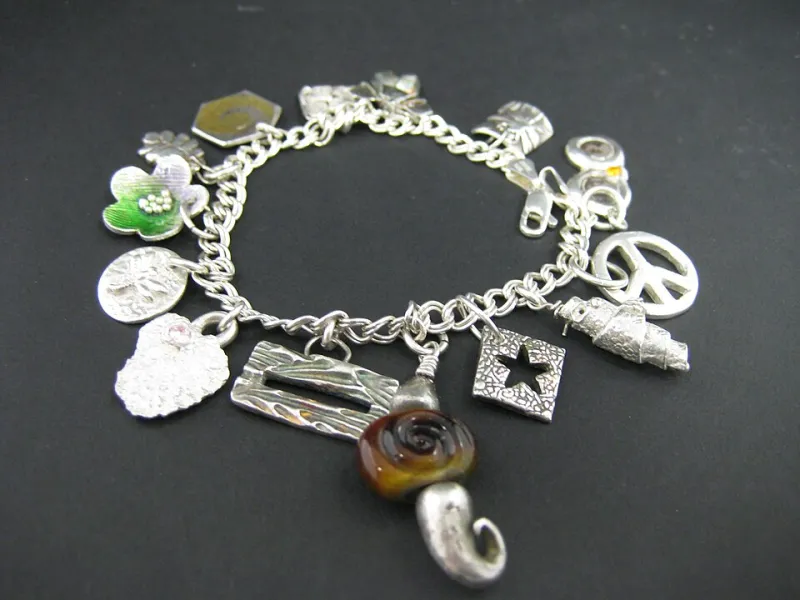
Pick a through-line before you buy. It might be a colour, a metal, a theme or a shape. One hero charm, two supporting charms and a spacer is a good starting point. Leave an empty link or two between them so the stack has rhythm. Mix retired pieces with current ones if you like, but repeat something — a stone colour, a motif, a finish — so the bracelet looks intentional.
Keep a wishlist and a budget. Clean every charm before it joins the bracelet. Note where you found it, even in a phone note. In a few years, that little provenance trail will be half the pleasure. A second-hand stack should feel collected, not random. That is the difference between a haul and a collection.