Space Between the Sparkle: An Argument for the Unfinished Charm Bracelet
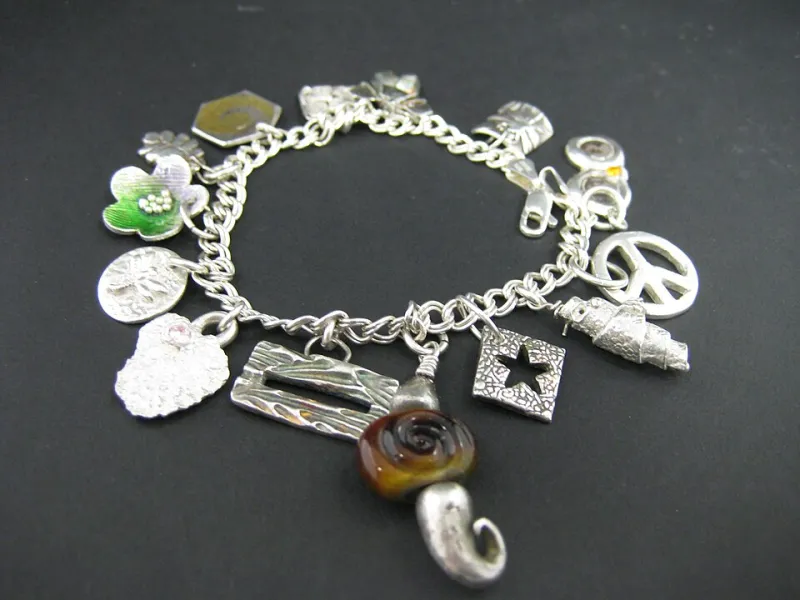
Photo: affinity, CC BY 2.0, via Wikimedia Commons
Walk through an Australian shopping centre in late 2026 and you will see the same reflex: more charms, more colour, more noise. A bracelet becomes a souvenir stall. It is fun for about ten minutes, then it becomes a jumble. The most interesting charm bracelets I have seen this year are not the fullest ones. They are the ones with room to breathe.
The empty link is a styling decision
A charm bracelet is not a storage device. It is a composition. Every charm you add changes the way the eye travels around the wrist. Negative space — the empty links between charms — is not a sign that you ran out of money or ideas. It is punctuation. A gap can be a comma, a full stop or a deliberate pause. It lets the next charm land properly.
That sounds precious, but it is practical. When charms sit shoulder to shoulder, they read as texture. When they are spaced, each one gets a silhouette. On a wrist, the bracelet moves. Charms slide, meet and separate. Gaps create small collisions and quiet moments. Without them, everything happens at once.
Why gaps change the rhythm of a stack
Think of a song. A verse with no space between the words is just noise. A charm bracelet works the same way. Two charms close together create a cluster. Two empty links after that create a breath. A single charm on its own creates emphasis. You can build a whole rhythm with three charms and a few gaps.
In 2026, I am seeing this most clearly on the wrists of people who have been collecting for years. They have plenty of charms at home. They are simply choosing not to wear them all at once. The result looks more confident. It also looks more personal, because you can actually see what they chose.
Plan negative space around your feature charms
Start with the charm you want people to notice. Give it a solo zone. That might mean one empty link on either side, or a clear section of bracelet before the next cluster. If you use clips, treat them as punctuation rather than filler. A clip can frame a feature charm beautifully, but two clips jammed together can look like a barricade.
Also plan on the wrist, not on the table. A bracelet laid flat can look balanced and then bunch up when you wear it. Try it on, let the charms fall, and see where the gaps actually land. You may need to move a charm one or two links to stop everything sliding into the clasp.
And do not fill every gap with a spacer just because you can. Spacers are useful, but a bracelet with no empty links can feel airless. The goal is not minimalism for its own sake. The goal is a stack with a pulse.
A three-charm bracelet can be more personal than a loaded one
There is a quiet snobbery in collecting that says a full bracelet is a serious bracelet. I do not buy it. A three-charm bracelet can tell a sharper story than a loaded one. One charm from a grandparent. One from a trip. One from a year that mattered. That is a sentence. A loaded bracelet is an archive, and archives are wonderful, but they are not always wearable.
Three charms also solve real-life problems. They are lighter, quieter and easier to style with a blazer, a work lanyard or a rainy Tuesday commute. They leave room for the bracelet to grow without looking unfinished. And they force you to edit. Editing is where personal style actually lives.
How to edit without regret
Take one charm off for a week. See what you miss. Keep the rest in a small dish by your jewellery box and rotate them when the mood changes. Try a two-link gap at the clasp, or move your feature charm to the opposite side of the wrist. None of this is permanent. That is the point.
The empty link is not an absence. It is a decision. In 2026, the bracelets that look most collected are the ones that trust the wearer to stop before the jangle takes over. Space is the luxury. Use it.